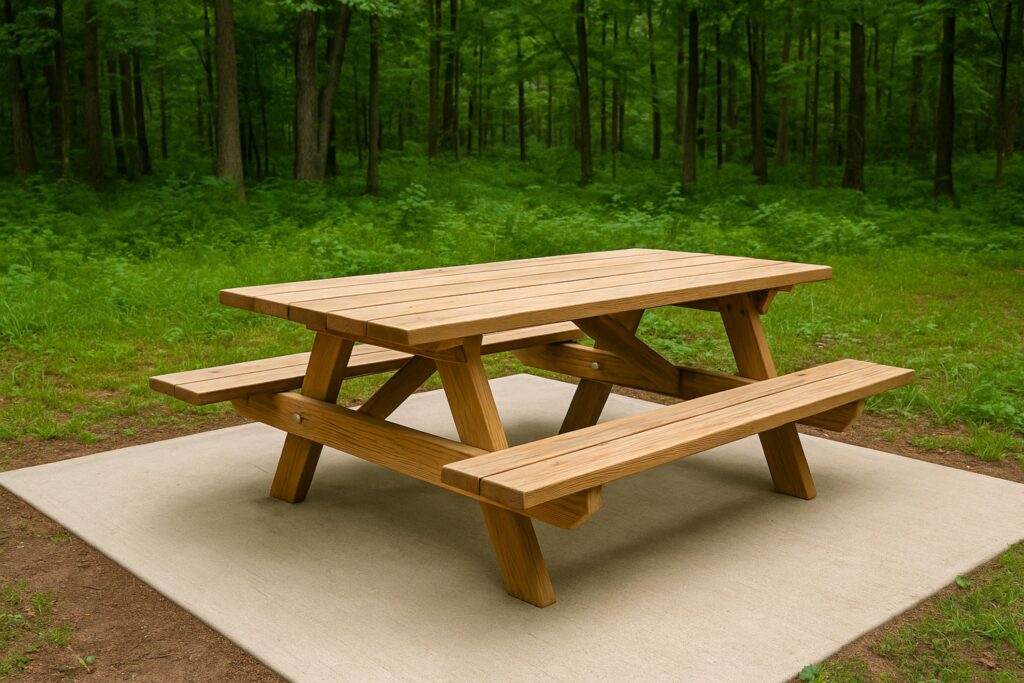
A picnic table is considered ADA-friendly when it meets the accessibility requirements set by the Americans with Disabilities Act (ADA). These requirements ensure wheelchair users have equal access, can approach the table safely, and can sit and use it comfortably.
To qualify, the table must provide:
- Correct tabletop height (28–34 inches from the ground).
- Knee and toe clearance under the table (minimum 27 inches high and 19 inches deep).
- Clear floor space at least 30 × 48 inches next to or under the table.
- Accessible approach routes with firm, slip-resistant surfaces at least 36 inches wide.
These technical standards are not optional. They are precise measurements that define ADA compliance, ensuring accessibility is functional—not just symbolic.
Why do ADA picnic tables require specific height and knee clearance?
The ADA sets exact dimensions so that wheelchair users can roll up to the table and fit their legs beneath it without obstruction.
- Height requirement (28–34 inches): This ensures the tabletop is neither too high nor too low for wheelchair users, aligning with average reach ranges.
- Knee clearance (27 inches high): Without this space, wheelchairs cannot fit under the table, forcing users to sit at an awkward angle.
- Depth requirement (19 inches minimum): This depth allows wheelchair users to pull up close enough to eat or work on the table comfortably.
Without these clearances, the table may appear accessible but would still be unusable in practice.
How much clear floor space must an ADA-friendly picnic table provide?
An ADA-friendly picnic table must have at least 30 × 48 inches of unobstructed floor space. This space allows a wheelchair to approach, turn, and position correctly at the table.
- The 30-inch width ensures that the wheelchair fits comfortably alongside the table.
- The 48-inch depth gives enough room for a forward approach.
- At least 19 inches of this depth must extend under the table, so the wheelchair user can pull in close enough to use it effectively.
If this clear zone is blocked by table legs, benches, or uneven ground, the table cannot be considered ADA-compliant.
Is having a removable bench enough to meet ADA requirements?
No. Simply removing a bench does not guarantee compliance. ADA standards go beyond making space—they require technical measurements and access routes.
A bench-free side might allow space for a wheelchair, but if the tabletop height, knee clearance, or surrounding path don’t meet ADA specifications, the table is still non-compliant.
Accurate compliance requires that all conditions are met together, not just partial adjustments.
What are common design strategies for ADA picnic tables?
Manufacturers and parks typically use a few design methods to ensure accessibility:
- Single-end access: One bench is left out at the end, creating a wheelchair-accessible space.
- Double-end access: Both ends are open, offering flexibility in approach.
- Side access with extended tabletop: The tabletop extends beyond the bench, allowing a side approach without removing benches.
These designs not only meet ADA standards but also integrate seating naturally, ensuring wheelchair users are not isolated from the group.
How many picnic tables must be ADA-friendly in public settings?
The ADA requires a certain number of tables to be accessible, depending on the location:
- Businesses and private facilities: At least 5% of tables, or one if fewer than 20, must meet ADA standards.
- Public parks and federal facilities: Often require at least 20% of tables to be accessible, or all if only one or two tables are installed.
This ensures accessibility is not rare or tokenized but consistently available across facilities.
What about accessible routes and surrounding surfaces?
An ADA picnic table is only accessible if the user can reach it safely. The ADA requires:
- Firm, stable, slip-resistant surfaces under and around the table (concrete, asphalt, compacted stone).
- Clear paths at least 36 inches wide leading to the table.
- No barriers such as curbs, steps, or uneven ground that block wheelchair access.
Without an accessible approach route, even the most compliant table becomes unusable.
What defines an ADA-friendly picnic table?
An ADA-friendly picnic table is not just a standard table with space removed—it’s a table designed to meet precise accessibility standards. It must provide:
- Tabletop height between 28–34 inches.
- Knee clearance at least 27 inches high and 19 inches deep.
- Clear floor space of at least 30 × 48 inches.
- Accessible routes with firm, slip-resistant surfaces and 36-inch-wide approaches.
- Proper distribution across facilities (5% in private, up to 20% in public parks).
When all these conditions are met, a picnic table truly allows wheelchair users to approach, sit, and enjoy it equally, fulfilling both the letter and spirit of ADA compliance.
FAQs
What is the minimum knee clearance required under an ADA picnic table?
At least 27 inches high and 19 inches deep. This clearance ensures wheelchair users can fit their legs under the table and reach the tabletop comfortably.
How wide must the accessible route be to reach an ADA picnic table?
The approach route must be at least 36 inches wide, with a firm and slip-resistant surface such as concrete or asphalt. This allows smooth wheelchair access.
Do all picnic tables in a park need to be ADA-friendly?
Not all, but a required portion must be. Typically, 5% of tables in private facilities and 20% in public parks must comply. If only one or two tables exist, at least one must meet ADA standards.
Can a wheelchair-accessible table still fail ADA compliance?
Yes. If the table lacks proper height, clearance, or accessible routes, it may allow access in theory but fail to meet the full ADA criteria in practice.
Where should ADA picnic tables be placed in a park?
They should be dispersed among other seating areas, not grouped separately. Integration ensures wheelchair users can sit with others rather than being isolated.
PS: If you notice a mistake or know of updated, officially issued ADA requirements that affect picnic tables, please send us a note. We aim to keep this information accurate and current for everyone.
✨ Love picnics as much as we do?
Join our community and get fresh picnic ideas, tips, and inspiration straight to your inbox. No spam, just simple ways to make every picnic special. 🌿🍓