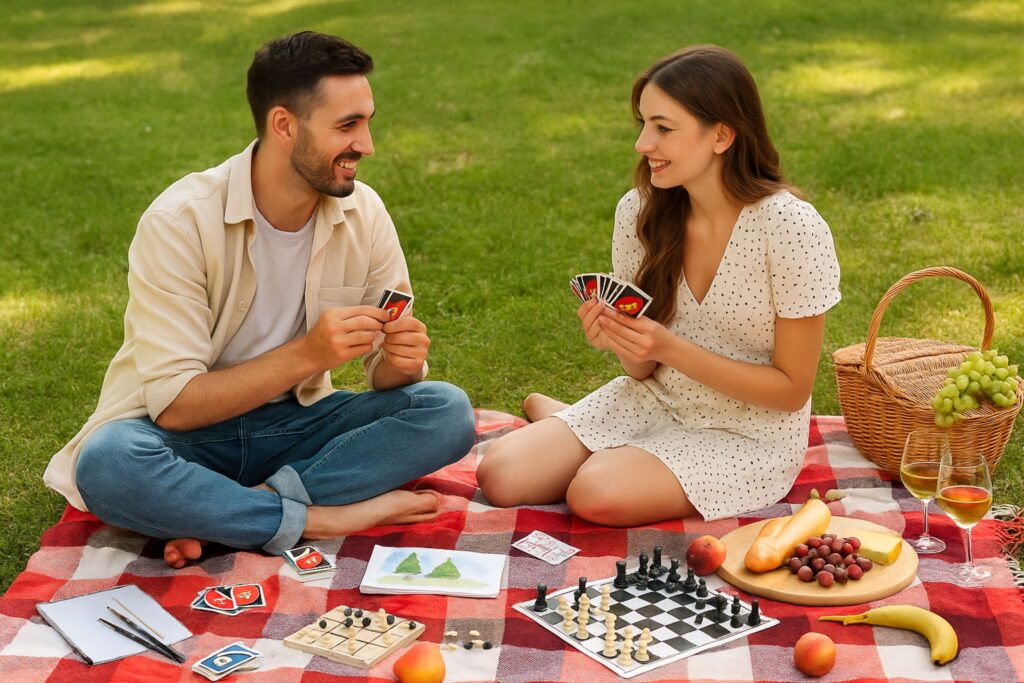
Picnic date games add energy and connection to an outdoor meal. From quick card matches to creative art contests and gentle sports, these activities spark laughter and conversation.
Each game is simple to set up, needs minimal gear, and helps couples enjoy a memorable time together in nature.
What Are the Most Popular Picnic Date Games for Two?
The most popular picnic date games combine easy setup with playful interaction. They keep couples entertained, encourage conversation, and fit comfortably on a blanket or small outdoor space.
Each option below explains what you need and how to play.
Nature Scavenger Hunt
What you need:
- A prepared list of natural objects to find—examples include a feather, a smooth pebble, a leaf with three colors, or a heart-shaped stone.
- A small bag or basket for each player to hold collected items.
- A phone or watch with a timer to keep track of the game period.
How to play:
- Create the list: Decide on 10–15 nature items that are likely to be found in the picnic area. Include easy (a pinecone) and slightly more complicated (a flower with five petals) challenges for variety.
- Set the rules: Agree on a time limit, usually 15–30 minutes, and clarify boundaries such as staying within the park or meadow.
- Start the hunt: Each person or team searches for the listed items. Players can work individually or as pairs.
- Check and score: When time is up, gather to compare finds. Award one point for every correct item and extra points for rare or creative discoveries.
- Declare the winner: The player or team with the most points wins. You can add a fun prize, like choosing the next snack or game.
Players: Ideal for two people on a picnic date, but easy to adapt for families or small groups. The game encourages exploration, observation, and gentle activity while maintaining a focus on shared outdoor fun.
Bottle Cap or Pebble Checkers
What you need:
- A checkerboard made by drawing an 8×8 grid on sturdy paper, cloth, or a foldable board. Darken alternating squares for clarity.
- 24 flat markers—use 12 bottle caps or smooth pebbles of one color and 12 of another. Choose contrasting colors so pieces are easy to tell apart.
- A stable surface, such as a picnic table, firm ground, or a hard picnic blanket to keep the board flat.
How to play:
- Set up the board: Place 12 markers of each color on the dark squares of the first three rows closest to each player.
- Move pieces diagonally: Players take turns moving one piece at a time, only on dark squares, moving forward diagonally.
- Capture opponent pieces: Jump over an opponent’s piece to capture it, removing it from the board. Multiple jumps in one turn are allowed if available.
- King a piece: When a piece reaches the farthest row on the opponent’s side, crown it as a “king” by stacking a second marker on top. Kings can move diagonally forward and backward.
- Win the game: The winner is the first to capture all opponent pieces or block them so no legal moves remain.
Players: Best suited for two people. Bottle caps or pebbles make it eco-friendly and easy to replace pieces if any go missing during the picnic.
DIY Trivia Quiz
What you need:
- A list of trivia questions prepared in advance or stored in a phone app. Use categories that interest you both, such as world travel, favorite films, music, nature facts, or personal memories.
- Paper and pens or a phone notes app for keeping score.
- A small treat or activity, such as picking the next picnic snack or music playlist, can be used as a prize.
How to play:
- Prepare questions: Create 20–30 questions divided into 3–5 categories. Include easy, medium, and challenging levels to keep it interesting.
- Set the rules: Decide how many rounds to play and how many points each correct answer earns – for example, one point for easy questions and two for harder ones.
- Ask and answer: Take turns reading questions aloud while the other player answers. If you’re using an app, set a time limit of about 30 seconds per question.
- Keep score: Record points after each round. The person with the highest total at the end wins.
- Award the prize: Offer the agreed-upon reward, such as choosing dessert or the next game.
Players: Ideal for two people on a picnic date, but simple to adapt for small groups by dividing into teams. This game blends friendly competition with learning and sparks plenty of conversation.
Couples Yoga or Stretch Challenge
What you need:
- A spacious picnic blanket or yoga mat large enough for two people to move comfortably.
- A list or app with beginner-friendly partner poses like seated twist, double-tree, or back-to-back chair pose.
- Optional items such as a phone timer, soft towels for extra padding, and a water bottle for hydration.
How to play:
- Set up your space: Lay the blanket or mat on level ground free of sharp stones or sticks. Ensure enough room around you to stretch safely.
- Warm up together: Begin with 3–5 minutes of gentle stretching, such as neck rolls or standing side bends, to loosen muscles.
- Practice partner poses: Choose simple poses suited to beginners. For example:
- Seated Twist: Sit back-to-back, cross your legs, and gently twist to touch each other’s hands.
- Double-Tree: Stand side by side, lift outer legs into a tree pose, and join hands overhead for balance.
- Back-to-Back Chair: Sit back-to-back and slowly lower into a seated squat, supporting each other.
- Seated Twist: Sit back-to-back, cross your legs, and gently twist to touch each other’s hands.
- Hold and breathe: Stay in each pose for 30–60 seconds. Focus on slow, steady breathing and give verbal cues to maintain balance.
- Add playful challenges: Try light contests like who can hold a gentle plank or a one-leg balance the longest. Keep it fun and supportive.
Players: Created for two people. This activity builds trust, promotes relaxation, and offers gentle physical exercise—perfect for a romantic picnic date.
Blindfold Taste Test
What you need:
- A soft eye mask or scarf to use as a blindfold.
- A variety of bite-sized snacks such as cheese cubes, fruit slices, chocolates, nuts, small pastries, or flavored dips.
- Napkins, small plates, and water for cleansing the palate between rounds.
How to play:
- Prepare the snacks: Before the picnic, cut snacks into easy-to-taste pieces. Keep bold flavors like citrus, sweet treats, and savory bites for variety.
- Set the rules: Decide how many tasting rounds you’ll play—five to ten is ideal. One partner wears the blindfold while the other selects a snack.
- Start guessing: Offer one sample at a time. The blindfolded partner tastes and tries to identify the food or its main ingredients.
- Switch roles: After each round or when the snack list is done, trade roles and repeat the challenge.
- Score and celebrate: Award one point for each correct guess. The winner can pick the next picnic activity or dessert.
Players: Perfect for two people. The game mixes sensory fun with playful competition, making it a memorable highlight of any picnic date.
Picnic Darts with Velcro or Magnetic Tips
What you need:
- A portable dartboard with Velcro or magnetic tips for safe outdoor play.
- Soft darts that securely stick to the board without sharp edges.
- A sturdy tree trunk, picnic shelter post, or foldable stand to hang or prop the board.
How to play:
- Set up the dartboard: Secure the board at eye level on a tree or stand. Make sure the area behind it is clear to prevent stray darts from disturbing others.
- Agree on scoring rules: Use standard dartboard scoring (1–20 points per section and a bullseye) or simplify it by awarding points for each successful hit.
- Take turns throwing: Players stand 6–10 feet away, depending on their skill and the available space, and throw three darts per round.
- Count and record points: Add up each player’s score after every round. Continue for an agreed number of rounds – commonly five – to determine the winner.
- Adjust for space or challenge: Shorten the distance for a quick game or extend it to increase difficulty.
Players: Best for two, creating friendly competition, but easy to adapt for small groups. Safe materials and a simple setup make this game ideal for parks, gardens, or beach picnics.
Build-a-Story Game
What you need:
- Just your imagination and a comfortable spot to sit together.
- Optional: a small notepad or phone notes app to record the evolving story if you’d like to read it later.
- A short list of fun keywords, such as sunset, picnic, guitar, or other personal favorites to spark ideas.
How to play:
- Decide on a theme: Choose a starting point like “a surprise trip,” “a hidden treasure,” or “an unexpected picnic guest.”
- Begin the story: One partner creates the opening sentence.
- Alternate turns: The other partner adds the following sentence, then switches back and forth to build the plot.
- Add creative prompts: Challenge each other to incorporate specific words or sudden twists – such as introducing a mystery object or a change in setting – to keep the story engaging.
- Wrap it up: After 10–15 minutes, agree on a fun or dramatic ending. If you wrote it down, read the whole story aloud for extra laughs.
Players: Designed for two people. This game sparks creativity, encourages quick thinking, and often leads to unexpected and entertaining storylines perfect for a relaxed picnic date.
Memory Match with Personal Photos
What you need:
- A small collection of printed couple photos or instant camera shots. Make two copies of each image so you have matching pairs.
- A flat surface, like a picnic table or firm blanket, to arrange the cards.
- Optional: a pouch or small box to keep the photo cards organized and protected.
How to play:
- Prepare the cards: Shuffle the photo pairs and lay them face down in neat rows.
- Take turns flipping: Each player flips two cards at a time, trying to find a matching pair.
- Score points: If the two cards match, the player keeps the pair and takes another turn. If they don’t match, place them back face down and let the other player continue.
- Add a personal twist: Whenever someone finds a pair, they share a short memory or story related to that photo.
- Determine the winner: The player with the most pairs when all cards are matched wins.
Players: Perfect for two. This memory-based game combines light competition with shared storytelling, making it a heartfelt activity for a picnic date.
Paper Airplane Distance Contest
What you need:
- Several sheets of lightweight or biodegradable paper. Recycled or compostable paper is ideal for eco-friendly play.
- A flat open area such as a park field, lakeside lawn, or quiet beach section free of obstacles.
- Optional: a measuring tape or marked line on the ground to track distances accurately.
How to play:
- Fold your airplanes: Each player designs and folds their own plane. Experiment with classic dart, glider, or stunt-plane folds for different flight patterns.
- Set the rules: Decide whether the winner is based on the most significant distance, the longest airtime, or the most creative flight path.
- Launch in turns: Stand behind a start line and throw one airplane at a time.
- Measure and score: Use a measuring tape or a natural landmark to gauge the distance each plane travels or the duration it remains airborne.
- Try new designs: After each round, modify folds or add minor adjustments to improve performance.
Players: Ideal for two but easy to expand for groups. This simple game combines friendly competition with creativity and works well in spacious picnic areas.
Bottle Bowling
What you need:
- Six to ten empty plastic bottles, each partly filled with sand or water for weight and stability.
- A small soft ball, such as a tennis ball or foam ball.
- Optional chalk or tape to mark the bowling lane and foul line.
How to play:
- Set up the pins: Arrange the bottles in a triangle formation, with one bottle at the front and the rest behind in rows. Make sure the ground is flat so the bottles stand firmly.
- Decide the scoring method: Use standard bowling rules (10 points plus bonus for strikes and spares) or a simple system of one point per bottle knocked down.
- Take turns rolling: Each player stands behind the foul line and rolls the ball toward the bottles. Each round allows two rolls to knock down as many bottles as possible.
- Track the score: After every round, record the number of pins knocked over. Continue for an agreed number of frames, such as five or ten.
- Declare the winner: The player with the highest total points at the end wins.
Players: Ideal for two, creating light competition on a picnic date, but it can also entertain families or small groups with minimal equipment and easy setup.
Charades with a Twist
What you need:
- Strips of paper with prompts such as movie titles, song names, nature scenes, or romantic themes.
- A small container or bag to draw prompts from.
- A timer or phone stopwatch to track each round.
How to play:
- Prepare the prompts: Before the picnic, write 20–30 ideas on paper slips. Add picnic-themed actions like spreading a blanket, pouring lemonade, or flying a kite for extra fun.
- Set the time limit: Choose a standard round length, such as 60 seconds, to keep the game lively.
- Act and guess: One player draws a slip and silently acts out the prompt using only gestures and body language. The partner must guess before time runs out.
- Score points: Award one point for every correct guess. Switch roles after each turn to keep the game balanced.
- Add creative twists: Include challenges such as acting with one hand behind the back or without standing up to make the game more unpredictable.
Players: Perfect for two people on a picnic date, but easily expandable to a small group. The mix of physical humor and themed prompts makes this version of charades both entertaining and unique for outdoor picnics.
Couples Trivia Challenge
What you need:
- A set of trivia cards or a prepared list of 20–30 questions. Mix general topics like world travel, music, or food with personal categories such as relationship milestones or favorite shared moments.
- A phone timer or small stopwatch to keep rounds fast-paced.
- Paper and pens to track scores.
How to play:
- Organize categories: Divide questions into sections like “Travel,” “Movies,” “Food,” and “Our Story.” Assign a point value to each category if desired.
- Set time limits: Give each player about 30 seconds to answer a question to keep the game lively.
- Ask and answer: Take turns reading questions while the other player guesses the answer. Award one or two points depending on difficulty.
- Add personal twists: Include inside jokes or memories (e.g., “Where was our first weekend trip together?”) to make the quiz more meaningful.
- Tally the score: After all rounds, add up points and declare the winner. Offer a fun reward, such as choosing the dessert or the next activity.
Players: Best suited for two people on a picnic date, but can easily include other couples or friends by preparing more question sets. This game blends friendly competition with shared memories for an engaging outdoor experience.
Mini Bocce or Petanque
What you need:
- A compact bocce or petanque set with 6–8 soft, wooden, or lightweight plastic balls.
- One small target ball, often called the jack or pallino.
- A grassy lawn, firm sand, or smooth dirt area roughly 15–30 feet long.
How to play:
- Set the field: Mark a starting line and clear away large rocks or branches.
- Throw the jack: One player tosses the small target ball a few meters away to start the round.
- Take turns rolling: Players alternate throwing their larger balls, aiming to land closest to the jack. Balls can gently bump others to change positions.
- Score the round: When all balls are thrown, measure the distance. The player with the closest ball scores one point for each of their balls closer to the jack than the opponent’s nearest ball.
- Continue play: Repeat rounds until a set point total—commonly 12 or 15—is reached.
Players: Ideal for two but easily expanded for doubles or small group play. The compact set and simple scoring make this game a relaxing, strategy-filled choice for a picnic date.
Partner Balance Game
What you need:
- A large picnic blanket or yoga mat to provide a stable, non-slip surface.
- Comfortable clothing and flat shoes or bare feet for better grip.
- An optional phone timer to track balance duration and increase the challenge.
How to play:
- Set up your space: Spread the blanket or mat on level ground free of stones or roots.
- Start back-to-back: Stand close together with backs touching and arms gently linked at the elbows or hands.
- Lean and balance: Slowly lean outward while keeping your back in contact, aiming to stay upright without stepping off the mat.
- Add challenges: Try one-legged stands, slow side bends, or gentle squats while maintaining balance. Use the timer to see how long each pose can be held.
- Track progress: Alternate poses and compare times to see which partner holds balance longer or with greater stability.
Players: Designed for two. This playful exercise strengthens coordination, builds trust, and adds an active element to a date at the picnic.
Watercolor or Nature Art
What you need:
- Small travel watercolor kits with brushes and a secure-lid water cup.
- Sturdy paper, postcards, or a lightweight sketchbook that can handle wet paint.
- Optional: clipboards or portable easels to keep paper steady outdoors and wet wipes for easy cleanup.
How to play:
- Choose a subject: Look around for inspiration, such as nearby trees, wildflowers, scenic views, or even portraits of each other.
- Set a time frame: Agree on a painting session of about 15–30 minutes to keep the activity relaxed yet focused.
- Create your artwork: Use watercolors to paint your chosen subject. Experiment with quick sketches, layered washes, or creative color choices.
- Share and compare: When finished, display your paintings side by side. Discuss what you liked about each piece or combine your work into a single joint painting.
- Preserve the memory: Let the artwork dry and store it flat to take home as a keepsake from your picnic date.
Players: Best for two. This calm, creative activity invites conversation and provides a personal memento while fitting naturally into a leisurely outdoor picnic.
Picnic Bingo
What you need:
- Bingo cards printed or hand-drawn with picnic- and nature-related items such as a butterfly, red-checkered blanket, picnic basket, squirrel, or someone flying a kite.
- Small markers, such as pebbles, beans, or reusable tokens, to cover squares.
- Optional clipboard or firm backing to keep the cards steady on uneven ground.
How to play:
- Set up the cards: Give each player one card and a handful of markers. Make sure each card has a unique mix of items.
- Observe your surroundings: As you relax and play, look for the listed items around your picnic area. Each time you spot one, place a marker on the matching square.
- Decide the winning pattern: Agree on a goal before starting—complete a horizontal, vertical, or diagonal line, or fill the entire card for a bigger challenge.
- Call out “Bingo!” The first player to meet the chosen pattern announces their win. You can continue the game to see who fills the entire card.
- Play multiple rounds: Shuffle items between games or swap cards to keep the challenge fresh.
Players: Great for two people on a picnic date and easy to expand for families or small groups. This game combines observation, friendly competition, and an easy setup that fits any outdoor setting.
Shadow Drawing Contest
What you need:
- Sheets of sturdy drawing paper or a sketchbook.
- Pencils, pens, or colored markers for outlining and decorating.
- Every day, picnic items with clear outlines, such as a thermos, fruit, sunglasses, or your own hands.
- Optional: clipboards or a flat board to keep the paper steady on grass or sand.
How to play:
- Set up in sunlight: Position the paper where natural light casts clear, sharp shadows. Morning or late-afternoon sun works well.
- Create the shadow: Place an object so its shadow falls entirely on the paper. Adjust the angle and distance until you see a distinct shape.
- Trace the outline: Carefully follow the shadow with a pencil or marker, capturing all details of the silhouette.
- Add artistic touches: Fill in the outline with patterns, colors, or extra designs to make the drawing unique.
- Compare results: After both players finish, display the artwork side by side and decide whose drawing is the most creative or lifelike.
Players: Ideal for two, but easily expandable for families or small groups. This activity combines creativity with nature’s light play, creating memorable picnic keepsakes.
Nature Sound Guessing
What you need:
- A peaceful outdoor setting where natural sounds like birdsong, rustling leaves, or flowing water are easy to hear.
- Optional: a soft scarf or eye mask to help the listener focus by blocking visual distractions.
- A brief list of potential natural sounds you might encounter in the area to inspire your ideas.
How to play:
- Prepare the space: Select a quiet area away from heavy foot traffic or loud music to ensure clear, natural sounds.
- Set the rules: Decide how many rounds to play—five to ten is ideal—and whether to use a time limit for each guess.
- Close and listen: One partner closes their eyes or wears a blindfold while the other creates or points out sounds, such as gently shaking branches, tapping stones, or highlighting distant bird calls.
- Guess the source: The listener describes or names each sound. Award a point for every correct guess.
- Switch roles: Alternate until both players have had equal turns making and identifying sounds.
Players: Perfect for two. This mindful game enhances listening skills, deepens appreciation of nature, and adds a calming, sensory experience to a picnic date.
Picnic Pictionary
What you need:
- A small whiteboard, chalkboard, or sturdy drawing pad.
- Erasable markers, chalk, or pencils for easy cleanup and multiple rounds.
- Slips of paper with picnic- or nature-themed words and phrases, such as ant hill, campfire, or sunset view.
- A timer or phone stopwatch to set the guessing limit
How to play:
- Prepare the prompts: Before starting, write 15–20 themed words or short phrases on slips of paper. Fold them and place them in a small container.
- Draw and guess: One partner picks a slip and begins drawing the object or scene without using letters, numbers, or words.
- Beat the clock: The other partner has a set time—commonly 60 seconds—to guess the answer.
- Score points: Award one point for every correct guess. Switch roles after each turn to keep the game balanced.
- Add variety: Introduce bonus rounds, such as drawing with your non-dominant hand, to increase the challenge and laughter.
Players: Perfect for two, but easy to adapt for small groups. Picnic Pictionary mixes creativity and friendly competition, making it a lively choice for an outdoor date.
Make a Picnic Date Special with the Right Games
These picnic date games help make picnic date special by adding laughter, friendly competition, and shared creativity. They turn quiet moments into engaging memories and keep the atmosphere light and fun.
Include them in your what to bring for a picnic list along with essentials like a picnic blanket, snacks, picnic drinks, and reusable tableware. Pack compact items such as a travel chess set, sketch pads, or a mini bocce kit. With the right mix of food, comfort, and games, every picnic date can feel personal and unforgettable.
FAQs
How can couples select games that align with their relationship stage?
Select activities that feel natural for how long you’ve been together. New couples may enjoy light icebreakers like trivia or bingo, while long-term partners might prefer creative tasks such as joint art projects or memory challenges that revisit shared experiences.
What are quick setup games for a last-minute picnic date?
Games requiring no preparation include shadow drawing, nature sound guessing, and 20 Questions. Keep a small notepad or phone app handy to create prompts on the spot.
Which picnic date games encourage deeper conversation?
Games like relationship quizzes, “Two Truths and a Lie,” or themed storytelling foster thoughtful dialogue. These let couples share memories and plans while keeping the mood relaxed.
How can technology enhance picnic date games?
Use smartphones for timer-based challenges, digital trivia apps, or music games like Name That Tune. Download content offline to avoid issues in areas with limited or no internet coverage.
What outdoor conditions should be checked before planning games?
Evaluate ground stability, shade availability, and wind levels. A firm, level surface is vital for games like mini bocce or Jenga, while strong winds favor compact, low-profile activities such as card games or quizzes.
How do you create a romantic atmosphere during active games?
Set the mood with soft background music, cozy lighting like fairy lights or lanterns, and a comfortable picnic blanket. Choose cooperative games, like partner yoga, that emphasize teamwork and closeness.
Are there eco-friendly options for picnic date games?
Yes. Use biodegradable paper for airplanes or bingo cards, natural objects for scavenger hunts, and reusable boards for drawing or Pictionary. Avoid single-use plastics to keep the area clean.
How can couples adapt games for evening picnics?
Bring LED lanterns, glow sticks, or reflective tape to keep play areas visible. Choose games that feature large pieces or rely on sound, such as music quizzes or storytelling games.
What safety tips should couples follow when playing outdoor games?
Select open, well-lit areas and stay aware of your surroundings. Use soft or magnetic game pieces to avoid injuries, and keep a small first-aid kit in the picnic bag.
Which games work well in small urban picnic spots?
Compact activities like travel chess, pocket-sized Jenga, and conversation cards fit perfectly in city parks or rooftop gardens where space is limited.
How to keep picnic games engaging for both introverts and extroverts?
Offer a mix of quiet activities – like drawing or trivia – and more dynamic games such as ring toss or partner yoga. This balance lets each person participate comfortably.
Can picnic date games double as keepsake-making activities?
Yes. Drawing, watercolor painting, and memory match with printed photos create lasting souvenirs. Couples can frame or scrapbook these items later.
How do you store and transport game pieces efficiently?
Use zip pouches, small containers, or resealable bags to keep items organized. Magnetic or foldable sets reduce bulk and prevent loss during transport.
What games help celebrate special dates like anniversaries?
Create personalized scavenger hunts with clues about shared milestones or prepare a “Guess the Year” trivia quiz featuring essential memories and events.
How can weather apps assist with planning picnic date games?
Check real-time forecasts to avoid sudden rain or wind. Apps like AccuWeather or Windy help decide whether to focus on active outdoor games or compact, sheltered activities.
What are budget-friendly game ideas for a picnic date?
DIY options include bottle bowling with recycled containers, homemade trivia cards, or drawing games using everyday stationery. These reduce costs while keeping the date fun.
How can couples include a light workout during picnic games?
Choose active games like mini badminton, frisbee, or balance challenges. Set playful goals, such as step counts or timed sequences, to combine entertainment with gentle exercise.
How do you wrap up picnic games without leaving waste?
Use a final checklist to collect all pieces and dispose of biodegradable items properly. Wipe down reusable boards and pack them in cloth bags, ensuring the area stays clean and eco-friendly.
✨ Love picnics as much as we do?
Join our community and get fresh picnic ideas, tips, and inspiration straight to your inbox. No spam, just simple ways to make every picnic special. 🌿🍓